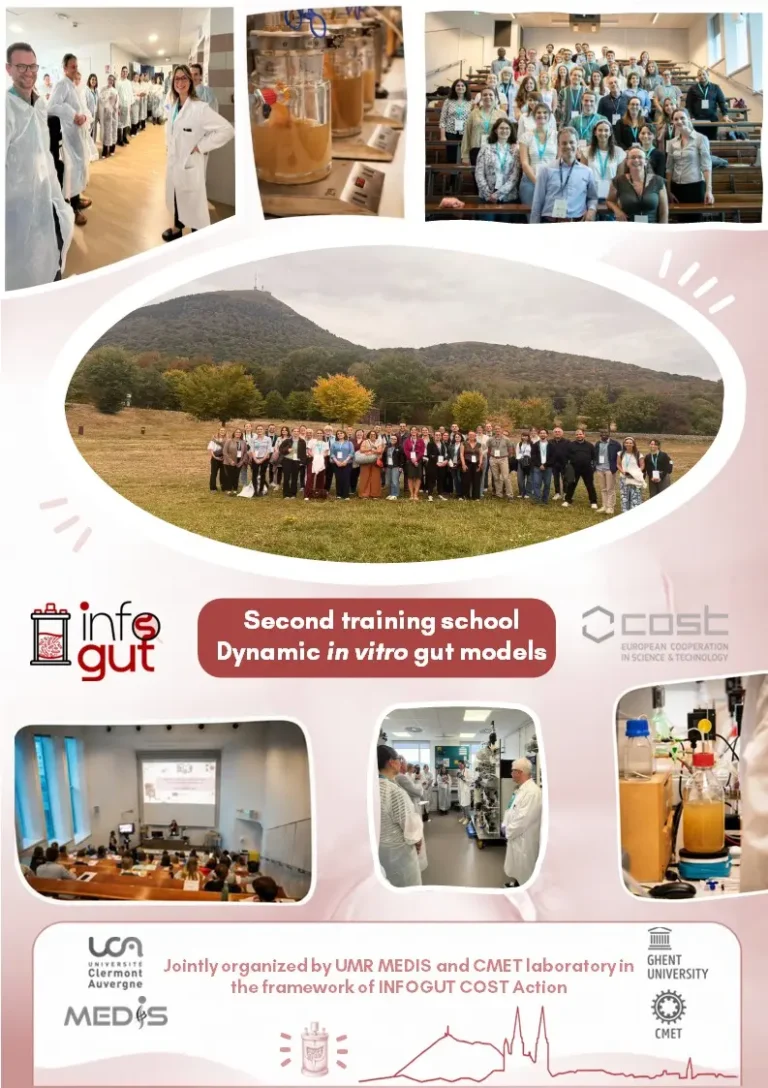
Looking Back on the 2nd COST INFOGUT Training School: Two days of Hands-On Learning in Clermont-Ferrand
12/10/2026 1 min read
On 30 September and 1 October 2026, MEDIS (Université Clermont Auvergne, France) and CMET (Ghent University, Belgium) jointly organised the second COST INFOGUT Training School, hosted in Clermont-Ferrand (France). This Scond Training School focused on advanced dynamic in vitro models of the human gastrointestinal environment, with particular emphasis on systems integrating oral and small-intestinal microbiota, high-throughput approaches and disease-related conditions. This directly supported COST INFOGUT Working Groups 2 and 3, addressing the extension of models to other gastrointestinal compartments and disease conditions.
The event brought together 20 early-career researchers from 14 European countries and 9 external trainers, while around 150 participants joined online. The programme combined scientific presentations with hands-on laboratory sessions, covering a broad range of in vitro models and approaches, including TIM, ARCOL, ARILE, ESIN, SHIME, mini-bioreactors and anaerobic culture methods. Participants had the opportunity to explore these models directly and exchange with the researchers, engineers and technicians who develop and use them.
The two-day event also fostered knowledge exchange, networking and collaboration across the COST INFOGUT community, while giving participants the opportunity to discover Clermont-Ferrand and the Auvergne region.
Organizers:
Stéphanie Blanquet-Diot Lucie Etienne-Mesmin Lidia Tomas Clarisse Nobre Andrea Gianotti